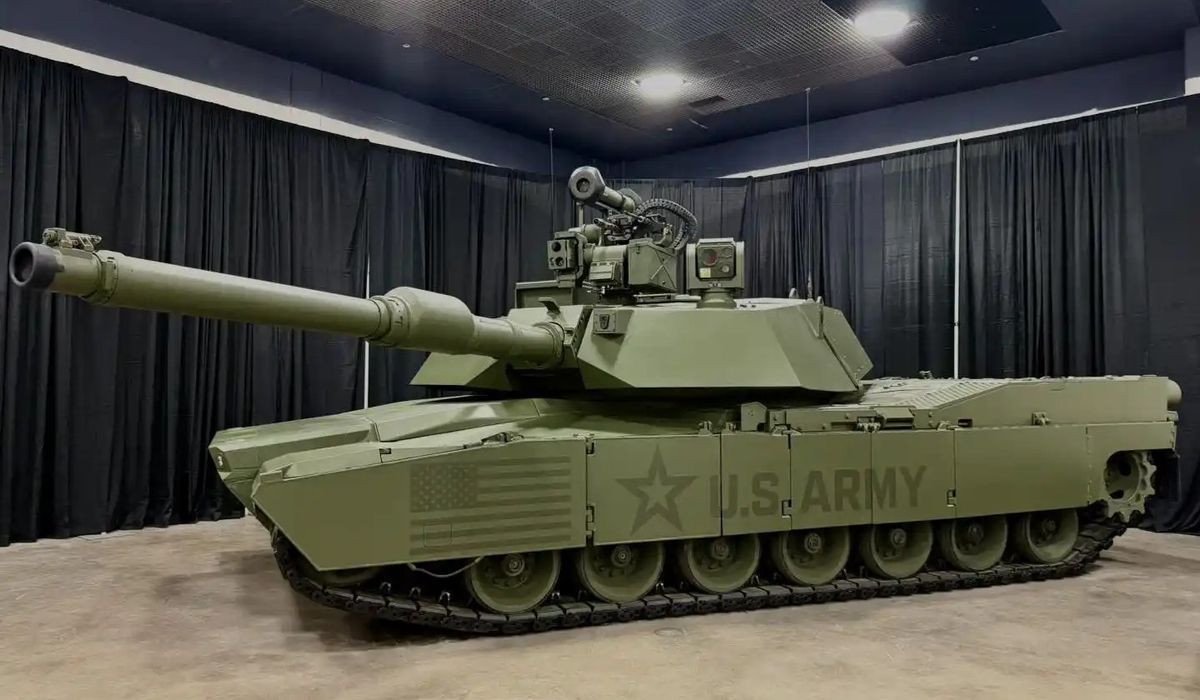
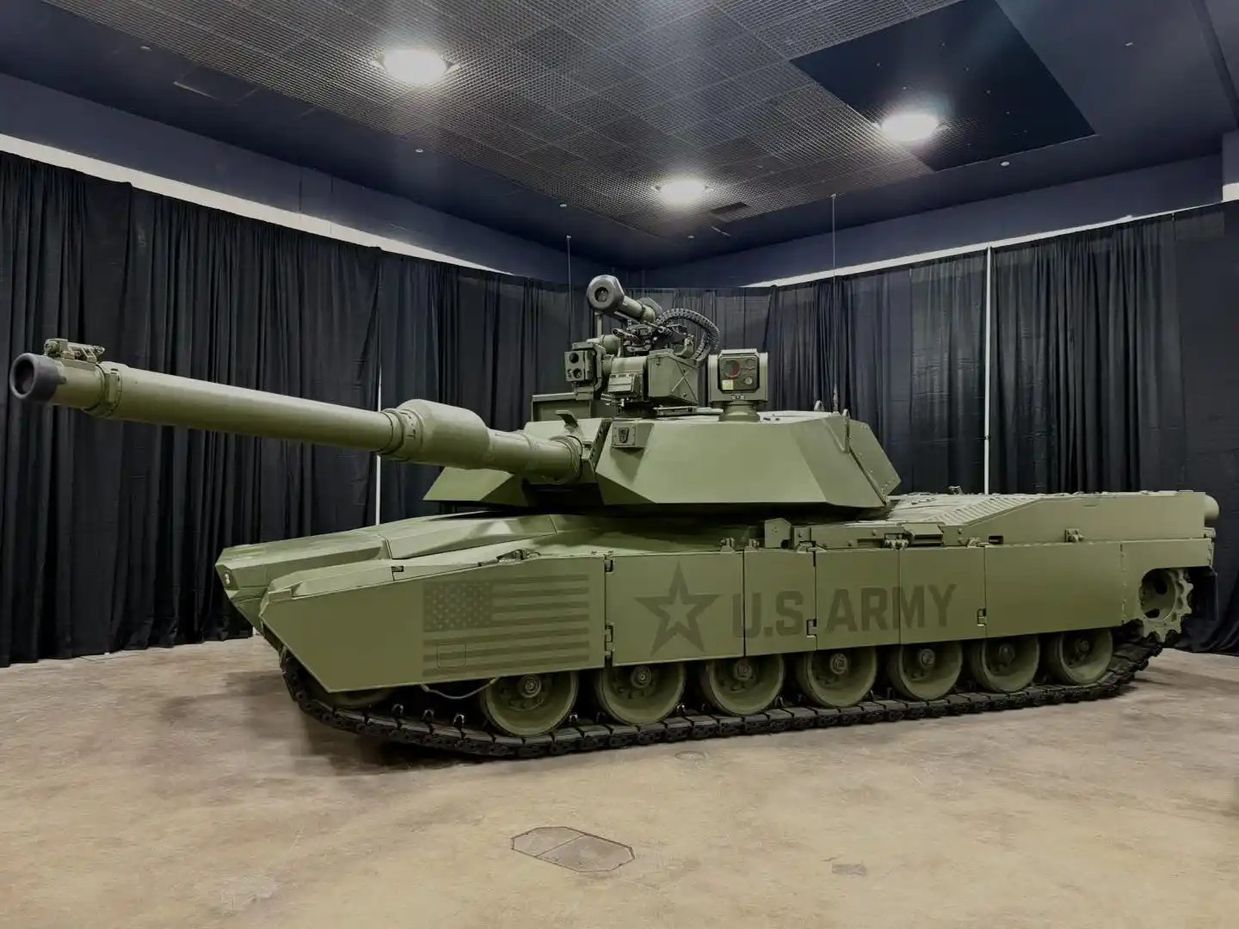
DETROIT — The U.S. Army showed off an updated M1E3 Abrams battle tank at the Detroit Auto Show this week, turning heads with a sleek new prototype that combines Motor City muscle and Formula 1 performance.
The slimmed-down 60-ton tank — previous versions topped 73 tons — includes a cockpit a Formula 1 team helped design and a gaming-inspired controller that can be exchanged for different styles of driving.
The roughly $75 million operational prototype on display was assembled by Roush, the Detroit-based, high-performance auto modifications company and racing manufacturer.
The Army expects a full platoon of four tanks to conduct experimental field operations this summer, starting with initial safety and gun testing.
Gen. Randy George, Army chief of staff, was flanked by automotive industry executives as he presented the tracked weapon to show attendees at Huntington Place in downtown Detroit.
The Army is actively recruiting American auto manufacturers to jump back into the defense industry after more than a 60-year hiatus, one official said, as part of the Trump administration’s effort to build what the Pentagon calls the “Arsenal of Freedom.”
“A year ago, we said we were going to build a tank and we were going to do it very rapidly,” Gen. George said. “And here we are at the Detroit Auto Show.”
The Department of Defense initially announced that an operational prototype wouldn’t be available until 2031.
The vehicle next to Gen. George on Wednesday is 25% lighter, uses half the fuel and is more technologically lethal than earlier versions of the Abrams tank.
The new Abrams can hit targets at almost 2 miles with precision, counter drones and deploy its own smart loitering munition drones, such as the Switchblade.
It hosts a crew of three in carbon fiber Recaro racing seats with crossed sabers and a tank — the branch insignia for the U.S. Army’s Armor branch — embroidered into the sparse padding.
A dashboard of monitors slides forward and locks into place once the soldier is seated, offering a full view outside. A Formula 1-style steering yoke, detachable and swappable, similar to racing, offers the controls.
“They can produce them at 10% the cost — with the embroidery — than what we pay for the majority of our seats today,” Col. Ryan Howell, the director of integration and program executive managing the development of the tank, said of the seats.
Col. Howell stressed that the Army is looking to commercial manufacturers to help reduce costs for the new vehicle.
“Diesel technology has come a long ways. Back in the ’80s, ’90s and even early 2000s, they looked at it, and it wasn’t quite there,” he said in an exclusive interview for the latest episode of The Washington Times’ “Threat Status” weekly podcast. “Well, now it is, and now it’s available in the commercial market at scale.
“The challenge on the turbine engine is, is the Army has to maintain that industrial base. So in many ways, we own the factories where all the parts are made,” Col. Howell said. “Now I get a commercial entity. I offload that risk.”
The Army is pulling in heavyweights from across American manufacturing.
Part of the new powertrain is from Caterpillar, the construction equipment manufacturer. Col. Howell said the approach offers significant savings down the road.
“Take the CAT engine, right? If I have to, I guarantee at places like Fort Hood, Texas, there’s a CAT dealer nearby,” Col. Howell said. “If I had to, and our soldiers didn’t have all the requisite training, I can take it down to the CAT dealer, and they can fix it, or I can go get their parts. Even better, in that case, I don’t have to re-create manuals. CAT’s already done that for their commercial customers.”
Much of the system will use the Society of Automotive Engineers standards for major parts.
The high-voltage electrical system will follow commercial industry standards rather than a military-specific design. It offers ease of maintenance, global supply chains and more rapid updates, the Army says.
The tank is also designed to integrate the Next Generation Command and Control System, which The Times saw tested in December.
The experimental system makes up what the Army is calling the “data backbone” of the new vehicle. NGC2 will go for full operational testing this summer, just after the tank is expected to begin its testing cycle.
The Army sees the intertwined nature as an opportunity, not a risk.
“I wouldn’t characterize it as a bet. I would characterize it as a decision,” said Alex Miller, the U.S. Army’s chief technology officer. “A bet means that we’re taking a chance, and we’re not. What we’re doing is adopting commercial technology.”
The goal of this new architecture, for both the new tank and NGC2, is to have military systems function more like modern cellphones. Software updates, new applications, and internet access mean fewer hardware updates are required. It also means faster and cheaper software-based products to meet new challenges on the battlefield.
“Soldiers are going to define that value for us faster than all of us at this table can come up with the good ideas,” Col. Howell said of the approach.
He hopes testing will yield new capabilities as the Army continues to integrate hardware and software designers directly into the process. The new process provides “leverage against the thoughts and ideas that young soldiers have” to adapt new technology and systems, ideas that Col. Howell says the Army “could never inject into the acquisition process” in the past.
This process, which the Pentagon has dubbed Acquisition Transformation Strategy, requires political support and budget flexibility, both of which the Army says it is receiving, though with limitations.
“Would I love the opportunity to have full funding flexibility? Absolutely,” Brent Ingraham, the assistant secretary of the Army for acquisition, logistics and technology, told The Times.
Mr. Ingraham said that although the Army and the Pentagon at large can move money around for different programs, the process is time-consuming as it currently works.
“There’s all sorts of restrictions and juggles that you’ve got to pull out a sort of a laundry list of things, a checklist to go through to figure out if you actually can or can’t move money around,” Mr. Ingraham said.
The changes the Pentagon is making and its messaging on procuring new technology are working.
The new system, still using the authorities they have, has already begun making changes and offering some transparency. Every program, Mr. Ingraham said, is now in a database that Congress can access, allowing it to see the individual steps, spending, and actions being taken to advance the program.
“We want the oversight, that’s not the issue,” Gen. George said. “Besides being more lethal, we’re trying to be much more efficient.”
He still appreciates the public push for change and the support not only for his leadership at the Pentagon but also for the White House and much of Congress.
“The top cover and the push is important with what we’re doing right here. Getting the support, it’s made a difference,” Gen. George said of the new process to buy equipment and its impact on developing the tank prototype. “We can do it very rapidly, and it’s not 2031 or 2032. We’ve had the top cover to move very rapidly in that area.”
Bringing traditional American commercial businesses back into defense will take time and effort.
Ford, General Motors, and Chevrolet have spent 30 of the last 60 years since producing military equipment for World War II building and leveraging global supply chains. Joining the defense industry will require reshoring more production to the U.S. to be compliant with the law.
Although many of the new tank’s parts came from American companies, they had to be sourced specifically from those companies’ smaller U.S.-based producers. The Army is confident that the industry can scale but is not yet willing to offer a timeline for the new tank.
Standing in front of the prototype on the Detroit Auto Show floor, a young man in the crowd asked Gen. George about exactly that.
“How soon will this be, like, deployed to the battlefield?” the attendee asked.
“That’s a really good question,” Gen. George said. “We’re taking four of these, and we’re going to get feedback from soldiers this summer … and that’s what we were just discussing. How quickly we would start producing these throughout our formation. Just in time for you to join and become a 19D.”
19D is an enlisted Cavalry Scout in the Army, something the young man wouldn’t be able to do for a few years. He is still in high school.