

Over the past 5 years, the S&P 500 is up an impressive 83%.
Meanwhile the Vanguard Emerging Markets ETF (VWO) has only risen 6.8% over that period.
Once you factor in inflation, emerging markets (EMs) are basically flat in real terms over the past 5 years.
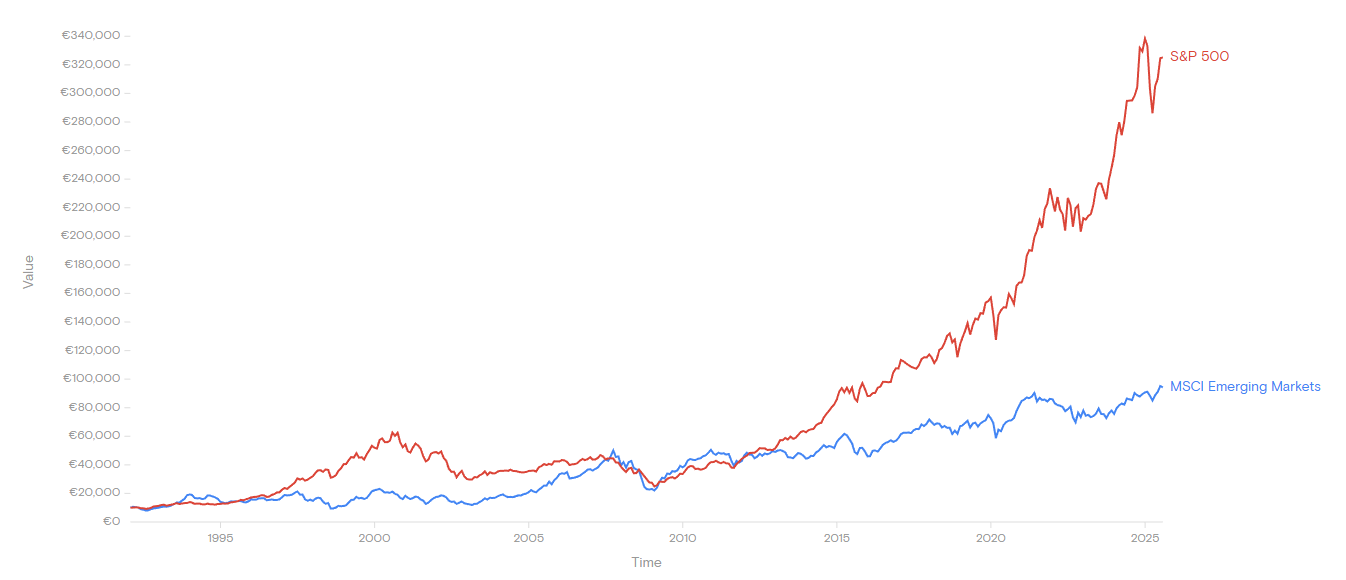
And this trend of U.S. stocks outperforming has been going on for more than a decade. The chart below covers 1990 to July 2025. The red line is the S&P 500, and blue is the MSCI emerging markets index.
Source: Curvo.eu
As you can see, from 1990 to around 2013, emerging markets and the S&P 500 produced around the same level of returns.
Then, American stocks raced ahead and have absolutely stomped EMs since. The combination of a strong dollar, QE, and the rise of big U.S. tech explains the difference.
As a result, the 2010s were an unusually bad period for EM returns. The following chart, via Morgan Stanley, shows EM performance going back to 1930 by decade.
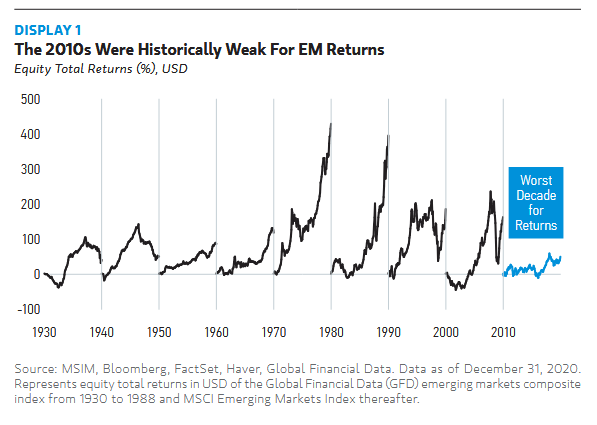
As you can see, EMs have historically generated strong returns. Except for the 2010s.
And look at the 1970s and 1980s! Over the 1970s, emerging markets returned approximately 400% in dollar terms. And then in the 1980s, they did it again.
The 1970s is especially relevant to today, as I believe we are set to have a similar inflationary experience. And when the dollar’s weak, EMs fly.
This extended period of underperformance in EMs is a gift for contrarian investors.
It’s Time (to Make Up for Lost Time)
In the past year, things have finally begun looking up for emerging markets. The Vanguard EM ETF (VWO) is up an impressive 40%, outperforming the S&P significantly.
I believe this is only the beginning of emerging market outperformance, and it will last for the next decade or so. EMs have a LOT of catching up to do.
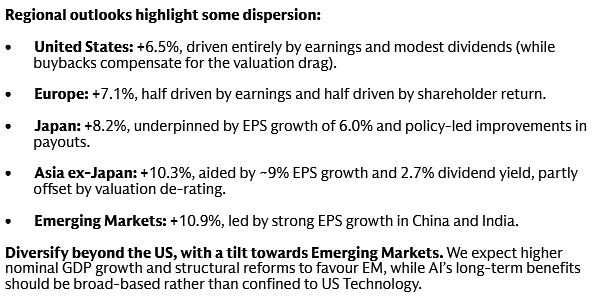
And guess what? Investment banking giant Goldman Sachs agrees. From Goldman’s 2026 outlook:
Source: GS 2026 10-Year Forecast
Analysts at Goldman Sachs expect U.S. stocks to return an average of 6.5% over the next decade. They expect emerging markets to return a far stronger 10.9%.
I would be surprised if American stocks manage to return 6.5% in real terms (inflation-adjusted) over the next 10 years, due to their ridiculous valuations. But let’s put that aside for now.
How to Invest in EMs
U.S. stocks have been so dominant for such a long time that many investors have zero exposure to foreign markets.
So these developing markets have gotten cheap. Dirt cheap, in some cases.
Looking at the Vanguard EM ETF (VWO), the average P/E ratio is 16. That’s about half the valuation of the S&P 500 today.
And the dividend yield on VWO is 2.67%, 2.6x higher than the S&P 500’s pitifully low 1%.
If you want very broad exposure to EM, VWO is a good choice. It holds more than 6,000 EM stocks from around the world. But it’s tilted towards China, so if you want to avoid that, best to pick something else.
For those seeking high yield EM stocks, I like the Cambria Emerging Shareholder Yield ETF (EYLD). This fund picks EM stocks based on their dividend and buyback yields. I’ve owned this one for 8 years, reinvesting the dividends, and it’s done very well despite poor EM performance.
Let’s Not Forget Brazil
Regular readers know I love Brazilian stocks. They’ve been so hated, for so long, that they’ve hit rock bottom valuations.
The iShares Brazil ETF (EWZ) trades at an average P/E ratio of just 11. That’s… real cheap. With a trailing dividend yield of over 5%, this is very attractive. However, there is a sizable expense ratio of 0.6%.
A cheaper option is the Franklin Latin America ETF (FLLA), with more reasonable 0.19% annual expenses. FLLA is mostly Brazil, but with a touch of Chile, Mexico, and other Latam exposure.
Besides cheap valuations, another reason I’m so invested in Brazil is because it’s a natural resource powerhouse. Iron, gold, copper, silver, oil, and much more. Returns and yields will rise strongly if commodities boom, as we expect them to.
In terms of individual names, I own oil firm Petrobras (PBR.A), industrial metal miner Vale (VALE), and online bank Nubank (NU). (Each of those links will take you to our coverage of that stock.)
EWZ, Vale, and Nubank have done very well since we covered them. Petrobras is the laggard, basically flat since, but this oil giant is our favorite way to play energy going forward.
Brazil offers juicy dividend yields and cheap valuations. Sure, there’s political and currency risk, but that’s the case everywhere these days.
Emerging Profits
EMs are set to generate big returns over the next decade and beyond.
Over the past year I’ve been shifting into them heavily, and will continue to. And when I set up my 16-year old son’s Roth IRA, the vast majority went into EM investments.
If you’ve been exclusively in U.S. stocks for the past 15 years, congratulations. You’ve done incredibly well.
Now it’s time to start looking to EM for alpha. America is entering a turbulent time, not unlike the 1940s or 1970s. The only guarantee is that vast sums of money will be printed.
EMs have their own issues to deal with, but considering the price we’re paying, my money is on emerging markets going forward.