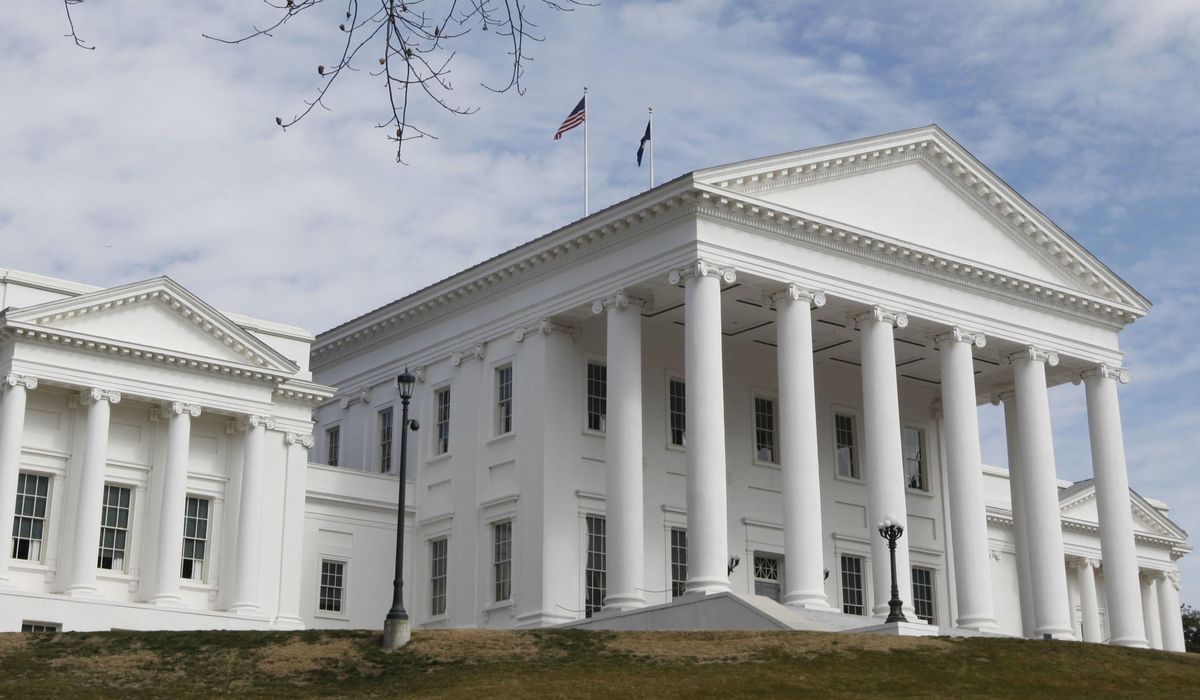

Second Amendment activists in Virginia are rallying opposition to a raft of gun control bills that Democratic lawmakers pre-filed for the 2026 legislative session in Richmond.
The bills will be at the top of the agenda when pro-firearm activists gather Jan. 15 in Richmond for the annual Lobby Day, where the lineup of speakers will include members of the Virginia Citizens Defense League and Gun Owners of America.
Those Second Amendment groups, as well as the National Rifle Foundation, are spotlighting eight new gun control bills that Virginia’s Democrat-controlled General Assembly and the soon-to-be sworn-in Democratic governor, Abigail Spanberger, appear ready to approve.
Topping the list is HB 217, which bans the importation, sale, manufacture, purchase and transfer of a wide range of commonly owned semi-automatic rifles, pistols and shotguns by classifying them as “assault firearms.”
The classification is based on features such as pistol grips, threaded barrels, folding or adjustable stocks, muzzle devices or the ability to accept detachable magazines.
“The U.S. Supreme Court has said in both D.C. v. Heller, and recently The New York State Rifle and Pistol Association v Bruen, that any firearm ‘in common use’ is protected by the Second Amendment,” said the Virginia Citizens Defense League.
“The guns and magazines targeted by this bill are among the most common guns and magazines in the United States, making this bill unconstitutional,” the group said.
Another bill scrutinized by pro-gun advocates would severely restrict Virginia’s concealed carry permit reciprocity with other states.
Currently, Virginia honors carry permits from all other states, which, in turn, enables Virginians to carry in most of those states.
Virginia residents can not use a permit from another state to carry in Virginia. They must have a Virginia concealed carry permit.
Other gun control legislation being considered in the state Senate and the House of Delegates holds gun manufacturers and dealers liable and potentially susceptible to multimillion-dollar lawsuits.
The bills require these firearm businesses to establish and implement “reasonable controls” over the manufacture, sale, distribution, use and marketing of firearm-related products.
National Rifle Association Legislative Action said the legislation is too “vague and subjective.”
“Further, they establish a broad civil cause of action, allowing the Attorney General, local government attorneys, or private individuals to sue firearm businesses for injunctions, damages, and costs,” it said. “These bills are a direct attack on the firearm industry and are designed to regulate the industry out of existence through litigation—despite longstanding federal protections.”
Republicans prodded to keep abortion restrictions on Obamacare subsidies
Pro-life organizations called out President Trump for telling Republicans that they needed to be “flexible” on a long-time federal law, known as the Hyde Amendment, that bans the use of federal taxpayer dollars, primarily through Medicaid, to pay for elective abortions.
The House recently passed a three-year extension of the enhanced Affordable Care Act subsidies without Hyde protections, a drastic break from the pro-life leadership of Speaker Mike Johnson, Louisiana Republican.
Democrats, though in the minority, were able to force the vote and pass the bill with the help of a handful of Republicans. The bill, however, is dead in the Senate.
Still, pro-life organizations want to make sure the Hyde Amendment is not ignored during the ongoing negotiation to extend the Obamacare subsidies.
Brad Kehr, government affairs director for Americans United for Life, said, “It is unconscionable that any House Republicans joined with Democrats to perpetuate the largest ever expansion of taxpayer funding for abortion.”
He added, “It is good for Congress to build a more effective and efficient approach to healthcare. But it must never be at the expense of preborn American life.”
Eagle Forum President Kris Ullman said there can be “no ‘flexibility’ on funding the destruction of innocent human life with taxpayer dollars.”
Ms. Ullman said, “For more than four decades, the Republican Party has stood against federal abortion funding. Now is not the time to retreat from even the most basic pro-life principles. … The Senate Republicans made it clear in December that they would not extend any Obamacare subsidies without protecting life.”
Trump warned against capping credit card interest rates
The Competitive Enterprise Institute took issue with President Trump’s proposal to cap annual credit card interest rates at 10%.
The libertarian think tank said that the White House and Sen. Roger Marshall, a Kansas Republican interested in having hearings on the issue, need to think beyond a quick-fix affordability plan.
“Their goals are to make credit more affordable and to keep people from getting into what they see as harmful debt,” CEI said in a blog post. “If Trump and Marshall really believe that price controls will work as they intend, then they are failing to heed Thomas Sowell’s advice about thinking beyond stage one.”
“Policy reform is not a one-stage process. Politicians cannot solve a problem by simply passing a bill. Credit card price controls will not magically make credit more affordable for the poor. Price controls have unintended, but not unforeseeable consequences.”
According to CEI, unintended consequences of capping the interest rates include banks reducing or eliminating credit offerings to borrowers who are deemed too risky to justify a 10% annual rate.
Another unintended consequence of an interest rate cap — which is a government price control — is that scarcer credit would add hurdles for people trying to launch businesses, said CEI.
What’s worse, the think tank said, is that price controls encourage black markets if banks are unavailable and payday lenders charge too much interest, some people may end up going to loan sharks or other criminal elements.