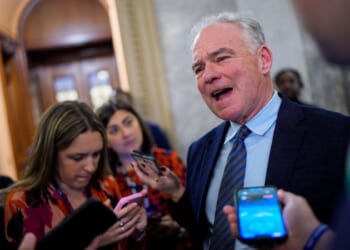
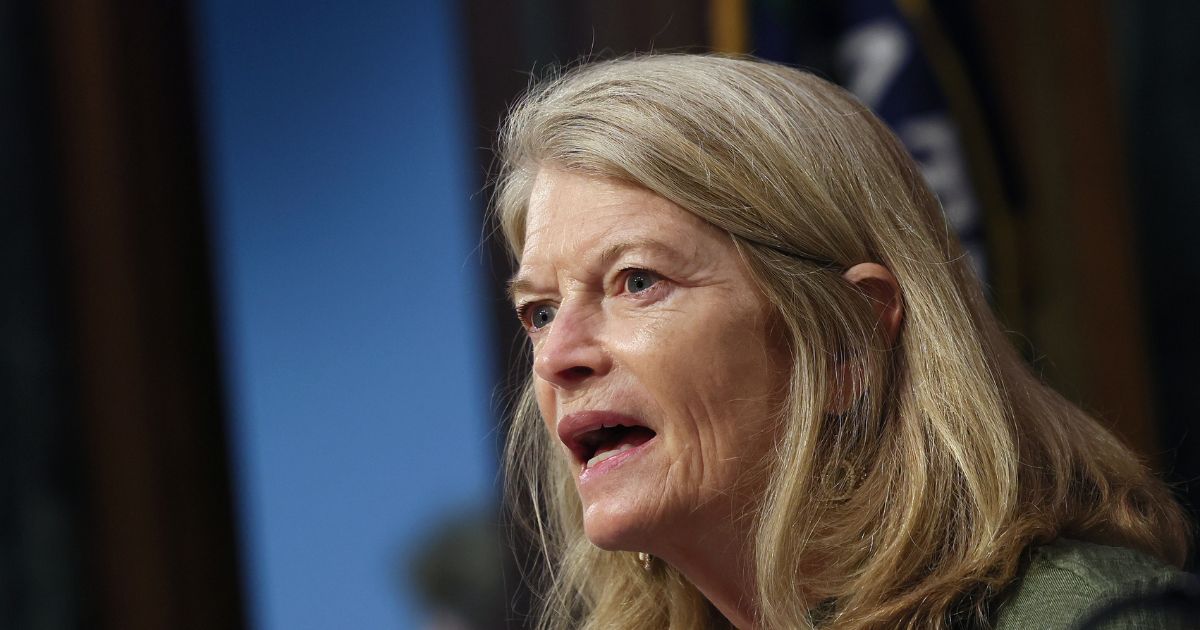
President Donald Trump strongly rebuked five Republican members of the Senate who sided with Democrats to advance a war powers resolution that would block the commander-in-chief from using U.S. military forces within or against Venezuela.
Democratic Sen. Tim Kaine of Virginia, joined by Senate Minority Leader Chuck Schumer, Sen. Adam Schiff of California, and Republican Sen. Rand Paul of Kentucky, introduced the resolution, which passed a procedural vote in the Senate 52-47 on Wednesday.
Trump responded after the vote with a Truth Social post, writing, “Republicans should be ashamed of the Senators that just voted with Democrats in attempting to take away our Powers to fight and defend the United States of America.”
“Susan Collins, Lisa Murkowski, Rand Paul, Josh Hawley, and Todd Young should never be elected to office again. This Vote greatly hampers American Self Defense and National Security, impeding the President’s Authority as Commander in Chief,” he continued.
“In any event, and despite their ‘stupidity,’ the War Powers Act is Unconstitutional, totally violating Article II of the Constitution, as all Presidents, and their Departments of Justice, have determined before me. Nevertheless, a more important Senate Vote will be taking place next week on this very subject,” Trump said.
Donald J. Trump Truth Social Post 12:49 PM EST 01.08.26
Republicans should be ashamed of the Senators that just voted with Democrats in attempting to take away our Powers to fight and defend the United States of America. Susan Collins, Lisa Murkowski, Rand Paul, Josh Hawley, and…
— Commentary Donald J. Trump Posts From Truth Social (@TrumpDailyPosts) January 8, 2026
It is not too surprising that Paul and Collins, who have voted against Trump on some key measures, including the “Big Beautiful Bill,” joined with the Democrats.
Murkowski’s vote is perhaps a little more unexpected. Though she is a moderate Republican, Alaska has a strong military presence and the highest percentage of veterans in the U.S.
In a social media post, she commended the military’s excellence in the apprehension of Maduro, but added, “Any future use of force or significant policy shift in Venezuela must include robust Congressional oversight and authorization, consistent with our Constitutional responsibilities, the rule of law, and a clear assessment of the benefits to the American people.”
Today, my colleagues and I voted to bring a resolution to the Senate floor that would require Congressional approval for further military operations against Venezuela. This will allow the Senate to begin debate on this measure following President Trump’s statements yesterday…
— Sen. Lisa Murkowski (@lisamurkowski) January 8, 2026
Perhaps the most surprising Republican defection was Hawley from Missouri, who wrote in a short post on X, “With regard to Venezuela, my read of the Constitution is that if the President feels the need to put boots on the ground there in the future, Congress would need to vote on it. That’s why I voted yes on this morning’s Senate resolution.”
With regard to Venezuela, my read of the Constitution is that if the President feels the need to put boots on the ground there in the future, Congress would need to vote on it. That’s why I voted yes on this morning’s Senate resolution.
— Josh Hawley (@HawleyMO) January 8, 2026
The Hill reported based on two unnamed sources that Collins, who is up for reelection in the fall, received a tongue-lashing from Trump over the phone after Wednesday’s vote.
Collins told reporters, “The president obviously is unhappy with the vote. I guess this means that he would prefer to have [Democratic] Gov. [Janet] Mills or somebody else with whom he’s not had a great relationship. I don’t know, I’m just not going to comment.”
Vice President J.D. Vance addressed the resolution on Wednesday, telling reporters, “Every president, Democrat or Republican, believes the War Powers Act is fundamentally a fake and unconstitutional law — it’s not going to change anything about how we conduct foreign policy over the next couple of weeks or the next couple of months and that will continue to be how we approach things.”
.@VP: “… every president, Democrat or Republican, believes the War Powers Act is fundamentally a fake and unconstitutional law – it’s not going to change anything about how we conduct foreign policy over the next couple of weeks or the next couple of months and that will… pic.twitter.com/3AZHSYV5SO
— Department of State (@StateDept) January 8, 2026
As the Vietnam War was winding down, Congress passed the War Powers Resolution in 1973, thereby requiring the president to notify Congress within 48 hours of introducing U.S. forces into hostilities.
Additionally, forces must be withdrawn within 60 days unless Congress passes an authorization of the use of force or declares war. The Supreme Court has not ruled on the constitutionality of the core provisions of the act.
Article II of the Constitution names the president as “Commander in Chief” of the U.S. armed forces, and Article I grants Congress the power to “declare war.”
Congress has officially declared war 11 times in its history, the last time being World War II, according to History.com.
The Korean War, the War in Vietnam, and the military operations in Afghanistan and Iraq all came at the direction of the president without a declaration of war. Congress did authorize the president to use force to respond to the perpetrators of the Sept. 11 attacks and to enforce United Nations Security Council resolutions against Iraq.
Congress ultimately has the power of the purse and, therefore, can always end military interventions by not funding them.

Advertise with The Western Journal and reach millions of highly engaged readers, while supporting our work. Advertise Today.