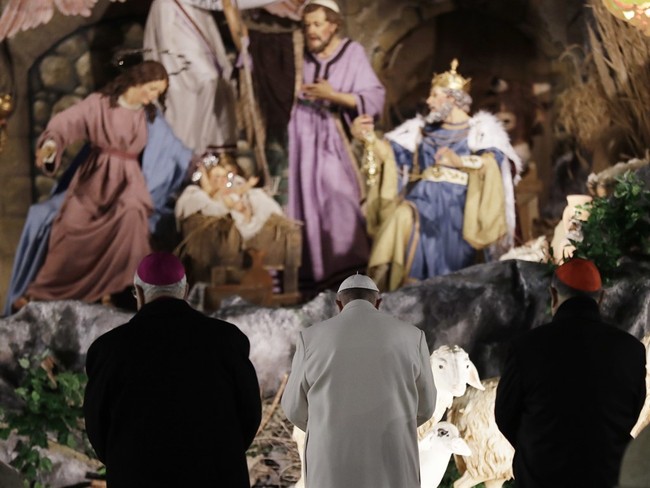
Every December, we tell the Christmas story again.
Joseph and Mary travel to Bethlehem. There is no room at the inn. Jesus is born in a stable and laid in a manger while animals look on. Shepherds receive angelic news in the fields and hurry to see the child. Later, wise men follow a star, seeking out a King born beneath it.
It is a story most of us could tell from memory, shaped as much by hymn and pageant as by Scripture itself. The images are familiar and comforting: a holy family alone in the cold, a quiet night, a humble beginning.
It’s also not accurate.
Nothing in the first chapters of Gospel of Luke needs to be changed to correct this inaccuracy. No verses are removed. No theology is revised. But without altering a single word of Luke’s account, several long-standing assumptions carried through the misinterpretation or misunderstanding of a few key words can be clarified — assumptions that have quietly reshaped how the story is imagined.
The “Inn” Wasn’t an Inn
Luke 2:7: “She wrapped him in swaddling clothes and laid him in a manger, because there was no room for them in the inn.”
Luke’s account hinges on the single word “inn.” When he explains why Mary and Joseph struggled to find a place to stay, the Greek term he uses is kataluma. Over time, that word has been commonly translated as inn, importing an entire mental picture — a commercial lodging, a keeper, and a refusal at the door.
But kataluma does not mean an inn in that sense. Luke uses a different word elsewhere when he wants to describe a public lodging place. Kataluma is a guest room, typically within a private home.
That distinction matters.
Luke does not say Mary and Joseph were turned away. He says the guest room was already full.
In a small town like Bethlehem, swollen by a census requiring families to return to ancestral homes, this would have been unremarkable. Extended families would have filled every available sleeping space in the homes of families who still lived in the town. Hospitality would have been offered as best it could be managed. What ran out was not goodwill, but room. Like an exended family today coming home for Christmas, people were placed where the host could find space for them.
Once the birth is returned to a private household rather than a roadside inn, the rest of the story begins to realign. The question is no longer why Mary was sent away, but where, within a crowded home, a birth could reasonably take place.
What a First-Century Jewish Home Looked Like
First-century Jewish homes were not organized like modern Western houses. Among other things, domestic architecture commonly included a central or semi-enclosed courtyard, not an ornamental space, but the functional heart of the household. It was used for work requiring light, ventilation, water, and cleanup, or for gathering large groups of people together for meals or socializing, or any variety of other things. Animals were often brought into or adjacent to this space at night for warmth and protection. Feeding troughs — mangers — were frequently built into walls or floors, made of stone or heavy wood.
This arrangement was not uniquely Jewish. It reflects a broader Near Eastern domestic pattern shaped by climate, economy, and long cultural continuity. Israelite households developed within that continuum, not apart from it. As far back as ancient Egypt, domestic courtyards were commonly used as spaces for childbirth. They were liminal areas within the home itself: open enough for light and air, easy to clean, and set apart from sleeping and food-preparation spaces. Birth did not require removal from the household, but it did require a space that could temporarily absorb danger, blood, and disruption. That same architectural logic persisted across the Near East, including in Jewish domestic life.
In such a home, a manger would not signal deprivation or rejection. It would simply be part of the domestic environment, sturdy, elevated, and immediately available.
So when Luke tells us that the child was laid in a manger, he is likely not moving the story into a detached stable. He is describing a practical detail within a lived-in household. The scene remains humble, but it is no longer marginal. It is domestic, crowded, and human.
Childbirth as a Liminal Event
In the ancient world, childbirth was a liminal event, suspended between life and death, danger and relief, impurity and restoration. Such moments were not handled casually. They required experience, coordination, and communal attention.
And childbirth was women’s work. They were the ones with the experience, understanding, and empathy for the job.
Men withdrew, not out of indifference, but because the work belonged to those who knew how to manage it. Women, especially older women, took charge. They directed, assisted, prepared, cleaned, and watched. Birth was not private in the modern sense; it was communal, because survival often depended on it.
In a town crowded by returning families, the house itself would already have been full, not only of men, but of women. The birth of a child, particularly to a young mother and the wife of a blood relative, would not have been treated as a private affair. Every capable woman present would have been pressed into service. Experience mattered. Birth was dangerous. The presence of many women was not ceremonial; it was practical, expected, and lifesaving. A space suited to physical exertion, bodily fluids, water, and movement would have been cleared and made ready. In a first-century home, the courtyard or lower domestic space fits that need exactly.
Seen this way, Mary was not relegated to a stable because there was “no room.” She was placed where birth customarily happened, in a space set apart for dangerous, necessary, and sacred work, surrounded by competent women.
Once the household is understood as full, the courtyard as a customary birth space, and women as the necessary attendants, the setting of the Nativity no longer appears improvised. It appears normal.
The Manger Reconsidered
Luke tells us that the child was laid in a manger, using the Greek word phatnē: a feeding trough. He offers no explanation and no theological aside. He simply names the object and moves on. That restraint matters.
A manger is not an altar. It is a practical object, sturdy, contained, and familiar to anyone who lived around animals. In a crowded household responding to childbirth, it would have made sense as a place to lay a newborn once he had been cleaned, swaddled, and settled.
Shepherds, in particular, would not have found this strange. They understood vulnerability. They knew how easily a newborn could be injured. They knew that when attention had to be divided and other animals still required tending, fragile creatures were placed somewhere protected and close at hand, like a feeding trough. And it is likely that often, a perfect lamb would be set apart in a manger so that the priests could take it as a sacrifice.
Nothing in Luke requires the manger to be symbolic in the moment. It is enough that it is specific. The sign given to the shepherds works because it is ordinary and recognizable.
Later Christians could not help noticing the resonance: the Lamb of God first laid where animals were fed and protected. Luke does not spell this out. The meaning emerges over time, once the whole story is known.
Liminal Actors and a Liminal Child
The Nativity is populated almost entirely by liminal figures — people who live and work at boundaries.
Women attend the birth because childbirth itself is liminal, poised between life and death. Shepherds receive the announcement because they live between settled society and wilderness, handling blood, birth, injury, and loss as part of daily life. They are neither elites nor outsiders, but something in between, ritually ambiguous, socially peripheral, and practically indispensable.
The Magi arrive later, and for a different reason. They are not guardians of fragile life, but boundary-crossers between cultures and nations. They do not belong at a birth, but at a recognition.
The shepherds witness the child’s arrival into life; the Magi recognize his meaning for the world. One belongs at a birth. The other belongs at a throne.
This is not accidental staging. Liminal moments require liminal witnesses, people accustomed to ambiguity, risk, and transition. The story does not begin in palaces or temples because it is not about maintaining established power. It is about the arrival of someone who will cross boundaries without destroying them.
Jesus himself is the ultimate boundary figure: fully human and fully divine; clean, yet willing to touch the unclean; alive yet destined to pass through death. From the beginning, his life occupies contested space.
Christmas and the Restoration of Order
This pattern of thresholds and careful crossings is not an innovation introduced at Christmas. It is a restoration.
The opening chapters of Genesis describe a world ordered by distinction rather than domination. Creation unfolds through separations: light from darkness, land from sea, heaven from earth. These boundaries are not barriers. They are the conditions that make life possible.
Human beings are created within this ordered world as embodied creatures, male and female together bearing the image of God. The text establishes shared dignity paired with difference. Authority is given for tending and keeping, not for control.
What follows after the Fall is not the correction of that design, but its distortion. Power concentrates. Vulnerability becomes suspect. The line “he shall rule over you” is not prescription but diagnosis, a description of what happens when trust collapses.
That is the world into which Christ is born.
God does not bypass the female body. He enters through it. He does not abolish the household. He sanctifies it. He does not erase difference. He works through it.
Women take authority where women have always taken authority: at birth. They again take authority at the other major human liminal moment: His death. Shepherds recognize what they are equipped to recognize: vulnerable life that must be protected. The Magi cross in later, representing the world’s recognition, not the immediate work of care.
Christmas is not the beginning of something new. It is the beginning of repair.
The Incarnation does not abandon the human order. It inhabits it fully, dangerously, and honestly. God enters the world where life has always entered it: through women, within households, surrounded by risk and love, attended by those who know how to guard what is fragile.
When Christmas is seen this way, nothing essential is lost but much is restored. The story becomes larger, more human, and more demanding, and in that fullness, more joyful than the thin version we repeat by rote.
Editor’s Note: Merry Christmas from all of us at PJ Media! You can support our work with a special Christmas discount this year.
Join PJ Media VIP and use the promo code MERRY74 to receive 74% off your membership.