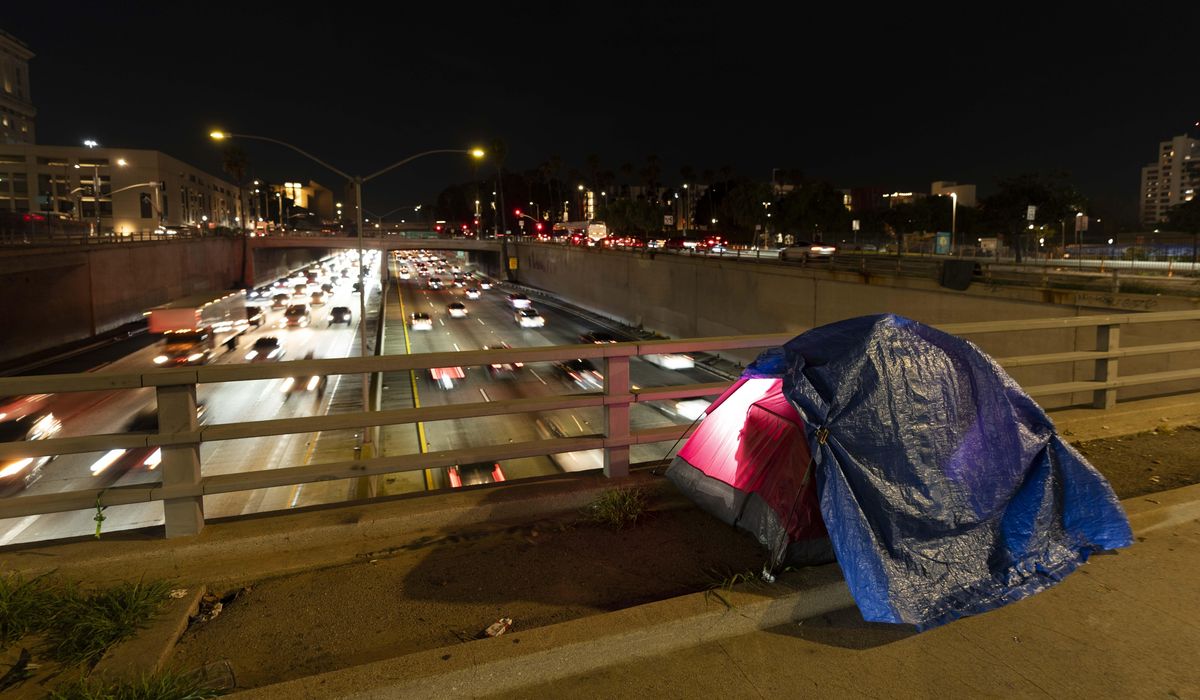
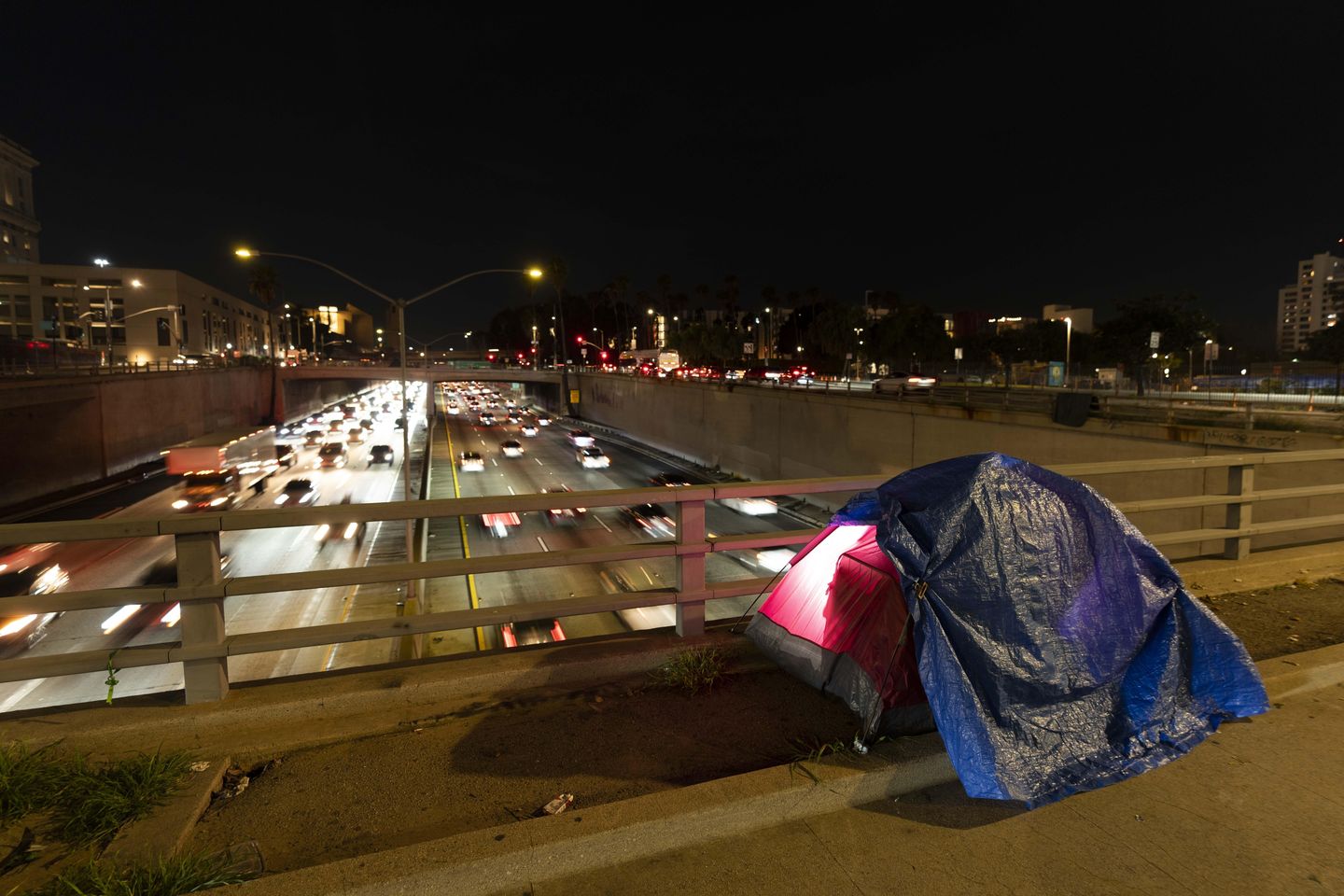
Legal barriers and scarce resources have long constrained the states’ authority in the involuntary commitment of mentally ill street people, making it a rare occurrence.
But growing numbers of mentally ill and drug-addicted homeless people have made involuntary, or civil, commitment a more viable option for policymakers across the country.
California, Oregon, Utah, Texas and New York are among several states that have moved in recent years to expand their legal criteria for forcing the homeless into psychiatric detox. And dozens of city governments have moved to criminalize homeless people dwelling in public spaces.
Moreover, the Trump administration recently shifted from a “housing first” model to a “treatment first” policy, tying federal grants for homeless services to institutionalized work and medical care requirements.
The Department of Housing and Urban Development estimates that a record-high 771,480 people slept on the streets in January 2024, or roughly 23 out of every 10,000 Americans. That’s up 18% from 653,104 a year earlier and up 33% from 2020.
“We are stopping the Biden-era slush fund that fueled the homelessness crisis, shut out faith-based providers simply because of their values, and incentivized never-ending government dependency,” a HUD spokesman said in an email.
The new HUD policies implement a July 29 executive order from President Trump to prioritize funds for state initiatives that ban public drug use, require psychiatric treatment and remove the homeless from public spaces.
A September analysis from KFF, an independent health policy think tank formerly known as the Kaiser Family Foundation, estimated that 18% of homeless adults last year were addicts and 22% were mentally ill.
Last month, HUD pledged to block states from spending $3 billion in grants on permanent housing programs that do not require the homeless to get sober first.
Some states have pushed back against the Trump administration, even as they move to expand the criteria for institutionalization. Led by New York, California, Kentucky and Pennsylvania, 18 states filed a lawsuit to block the federal cuts.
California, where one-quarter of the nation’s unhoused people live year-round due to mild weather and public drug use, reported spending $683 million in federal grants on “permanent supportive housing” in 2024.
Responding to legal challenges, the Trump administration announced in a Rhode Island court filing this month that it would rethink the cuts and issue new guidelines in January.
California Gov. Gavin Newsom, a Democrat, launched a new court system last year to compel up to 24 months of treatment for Californians with psychotic and schizophrenic disorders. He also signed legislation updating conservatorship requirements to make more unhoused people eligible for court-appointed guardianships.
“The governor has been forward-thinking in how to address mental health for those most at risk,” Tara Gallegos, Mr. Newsom’s deputy communications director, said in an email. “The Trump administration’s efforts to address mental health, which are ill-defined and only in nascent stages through Trump’s wishful and ineffective EO, fall far behind what is happening in California.”
Once commonplace, public mental hospitals started vanishing in the 1970s due to funding cuts and public outcry against lobotomies and electroshock treatments.
Policymakers changed involuntary commitment laws, making it illegal to compel residential addiction or mental health treatment in all but the most extreme cases.
According to the nonprofit National Alliance on Mental Illness, “all people should have the right to make their own decisions” about psychiatric treatment.
“However, in rare instances where voluntary engagement is not possible, NAMI supports involuntary civil commitment only when used as a last resort and only when it is believed to be in the best interests of the individual,” reads a statement on the alliance’s website.
Several policy experts warned The Washington Times that both the Trump and Newsom policies could worsen the situation, despite their shared intention of getting people off the streets.
“Both policies have done little so far,” said Judge Glock, a senior fellow at the conservative Manhattan Institute.
“The Trump policy has had little effect because commitment laws are almost entirely state-based,” Mr. Glock said. “The California legislation’s effect has been limited because the process for petitioning for commitment was onerous and it focused on psychotic disorders.”
Optics or overhaul
The nonprofit news outlet CalMatters estimates that only 528 people had entered treatment plans through California’s new court system as of July, despite Mr. Newsom predicting that 7,000 to 12,000 people would be eligible.
That included just 14 Californians placed on court-ordered plans, with the other 514 coming from voluntary agreements.
Nationally, a study published Friday in JAMA Health Forum projected that Mr. Trump’s executive order to defund “housing first” programs will increase homelessness by 5% within a year.
Lead author Kirk Fetters, a physician and clinical infectious diseases fellow at the University of Colorado Anschutz Medical Campus, said that means pushing up to 44,590 people back onto the streets.
“Everyone wants to end the homelessness crisis, but our study shows that this isn’t the way to do it,” Dr. Fetters said in an email. “Involuntary commitment is not an effective solution to homelessness, but it will substantially worsen the lives of people experiencing homelessness.”
Advocates of involuntary commitment warn that mental illness prevents most homeless addicts from recognizing that the drugs they use to self-medicate are harmful, making them unlikely to seek help.
Matt Dorsey, a Democratic member of San Francisco’s Board of Supervisors who supports arresting homeless addicts for compulsory detox, said housing first policies have turned his district south of Market Street into an open-air fentanyl party.
“It’s time to crash the party,” Mr. Dorsey, a recovering addict, said in a phone interview. “People are going to start voting with their feet and abandoning the cities if we don’t turn this around.”
He said that 26% of overdoses citywide now occur among former homeless people in taxpayer-subsidized housing who spend most of their time scaring people away.
At least half of all public drug users in his district’s Sixth Street corridor live in permanent supportive housing that costs up to $1 million per unit, he added.
California law currently disallows sober housing options for the homeless. In October, Mr. Newsom vetoed legislation that would have changed that.
Kevin Brown, a criminologist teaching at Arkansas State University, said an ongoing lack of public funds to serve the growing homeless population limits housing-first and treatment-first policies alike.
“Housing someone without treatment could lead to eviction and them ending up back on the streets,” Mr. Brown said. “Likewise, providing treatment without proper housing or shelter often results in little success, as many do not show up for treatment or pick up their medications.”
Seeking solutions
Homeless advocates say the best policies are those that hold mentally unstable addicts against their will only temporarily and push them toward employment once they sober up.
Mr. Dorsey praised the impact on San Francisco of 12-step groups, medicines to reduce addiction cravings and an “involuntary sober center” that Democratic Mayor Daniel Lurie plans to open next spring. The sober center will allow police to detain addicts there until they sober up and rearrest them if they flee.
“The problem is that San Francisco is a magnet for drug-related, bad behavior,” he said. “What will save money is turning off the magnet. People coming to the city should have three options: Get sober, get arrested, or get out.”
Mary Theroux, an advisory board member of the San Francisco Salvation Army who has worked with the homeless, agreed.
“People aren’t experiencing homelessness because they lost their house,” said Ms. Theroux, CEO of the free-market Independent Institute in Oakland, California. “The main reason is mental illness and substance addiction.”
Several homeless advocates said it’s long past time to end “housing first,” a policy the George W. Bush administration first endorsed nationally in the early 2000s.
“Placing drug addicts or the mentally ill in a government-provided home does not address the cause of their homelessness,” said Paul Larkin, an analyst at the conservative Heritage Foundation and former Justice Department attorney. “It only changes the location where they live.”
Scott Ackerson, a former administrator at Haven for Hope in San Antonio, Texas, one of the nation’s largest homeless treatment centers, said most social service agencies would be better off without federal and state governments dictating policy.
“I believe greater autonomy to address homeless intervention at the local level would lead to greater innovation in homeless response systems,” said Mr. Ackerman, a licensed social worker. “We need to prevent people from entering homelessness while simultaneously strengthening homeless intervention systems.”