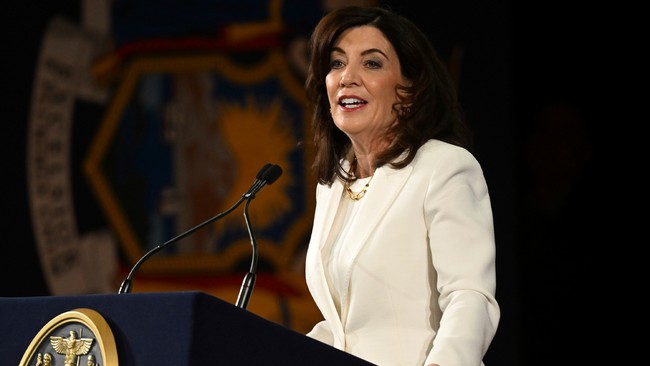
New York Gov. Kathy Hochul announced on Wednesday that she would support an amended version of the controversial assisted suicide bill that the legislature passed in June.
In an essay published in the Albany Times-Union, Hochul invoked her Roman Catholic religion in an attempt to justify her decision to sign a bill that the church strongly opposes.
She wrote that “there are individuals of many faiths who believe that deliberately shortening one’s life violates the sanctity of life. I understand and respect those views.”
She says she sees the issue as an “individual choice” that’s not “about shortening life but rather about shortening dying.”
That’s been the marketing strategy of assisted suicide in the other 12 states and Washington, D.C., where it has been approved. It’s a nonsensical statement because, first and foremost, killing yourself does indeed shorten your life, and any other fact becomes irrelevant once you’re dead.
Some people suffer horrific pain and anguish when they are dying. There are palliative measures doctors can take to ease that suffering. Modern pharmacology can make a patient’s passage from this life to the next relatively pain-free, and an entire medical industry has been created to deal with a dying patient’s care.
Nothing can be done about the mental anguish of realizing you’re about to face “the great unknown.” It sucks to die. Ending that anguish might be tempting, but the problem, as Canada and other nations have discovered, is that assisted suicide is a bottomless pit. It’s the ultimate slippery slope because once you can justify assisted suicide, the reasons to allow it expand exponentially.
The Canadian law, known as Medical Assistance in Dying (MAiD), has undergone radical revisions in less than a decade.
MAiD was first legalized in 2016 for Canadians whose death was “reasonably foreseeable.” At the time, a person had to have a grievous and irremediable medical condition which caused enduring physical or psychological suffering to qualify for euthanasia. Think of someone with a terminal cancer prognosis.
In 2021, just five years after legalization, MAiD was expanded to include those whose “death is not reasonably foreseeable.” With this expansion, people with disabilities or non-terminal illnesses could choose to have a doctor end their lives. Think of someone who is wheelchair bound.
The next expansion has already been passed into law, but implementation has been delayed until March 17, 2027. This would allow Canadians suffering solely from a mental illness to be eligible for euthanasia. Think of someone suffering from depression.
“Between 2016 and 2023, over 60,000 Canadians have been euthanized, with over 15,000 in 2023 alone. Euthanasia now accounts for 4.7% of all deaths in the country, a rate second only to the Netherlands,” according to Dordt. “Euthanasia is now the fifth most common cause of death in Canada.”
In Canada, it’s easier to access assisted suicide services than healthcare. I wrote this when parliament was debating adding mental health to the list of conditions that would justify assisted suicide:
What should be clear to even the most casual observer is that there is no “middle ground” with euthanasia advocates. This is exactly the reason we should be terrified of these people. Their goal is not “compassion” but victory. Outside moral judgments must not play a role in “individual autonomy.”
In her essay, Hochul wrote of her own experience with her mother, who was dying of ALS.
“I watched my own mom die from A.L.S.,” she wrote, referring to amyotrophic lateral sclerosis, also known as Lou Gehrig’s disease. “I watched that vicious disease steal away the strong woman who raised me as it took her ability to walk, to eat, to speak and, ultimately, to live. I am all too familiar with the pain of seeing someone you love suffer and feeling powerless to stop it.”
Are we not allowed to think through the consequences of assisted suicide, primarily the very real “slippery slope” argument that has manifested itself in a nightmarish way in Canada?
Exclusively for our VIPs: X Community Notes’ Despicable ‘Fact-Check’ of Israeli Archeology
When moral considerations take a back seat to emotions and feelings, something essential is lost: the value and sanctity of human life. The “divine spark” that makes each of us living, thinking, feeling animals must be protected, nurtured, and fought for until that spark is extinguished naturally.
It’s the human thing to do.
Happy holidays from PJ Media! We have a YUGE Christmas/New Year sale! Take 74% off your new VIP subscription using the code MERRY74.
You’ll get some of the best conservative writing around, and at a fantastic price. Celebrate the holidays the right way!