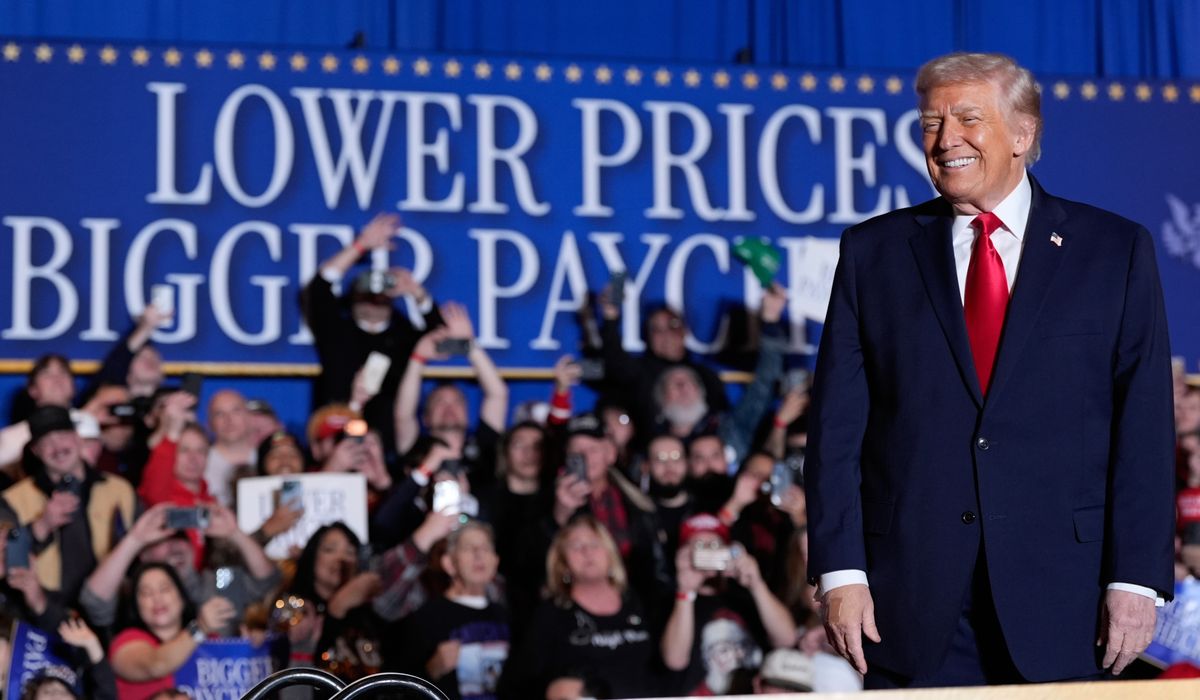
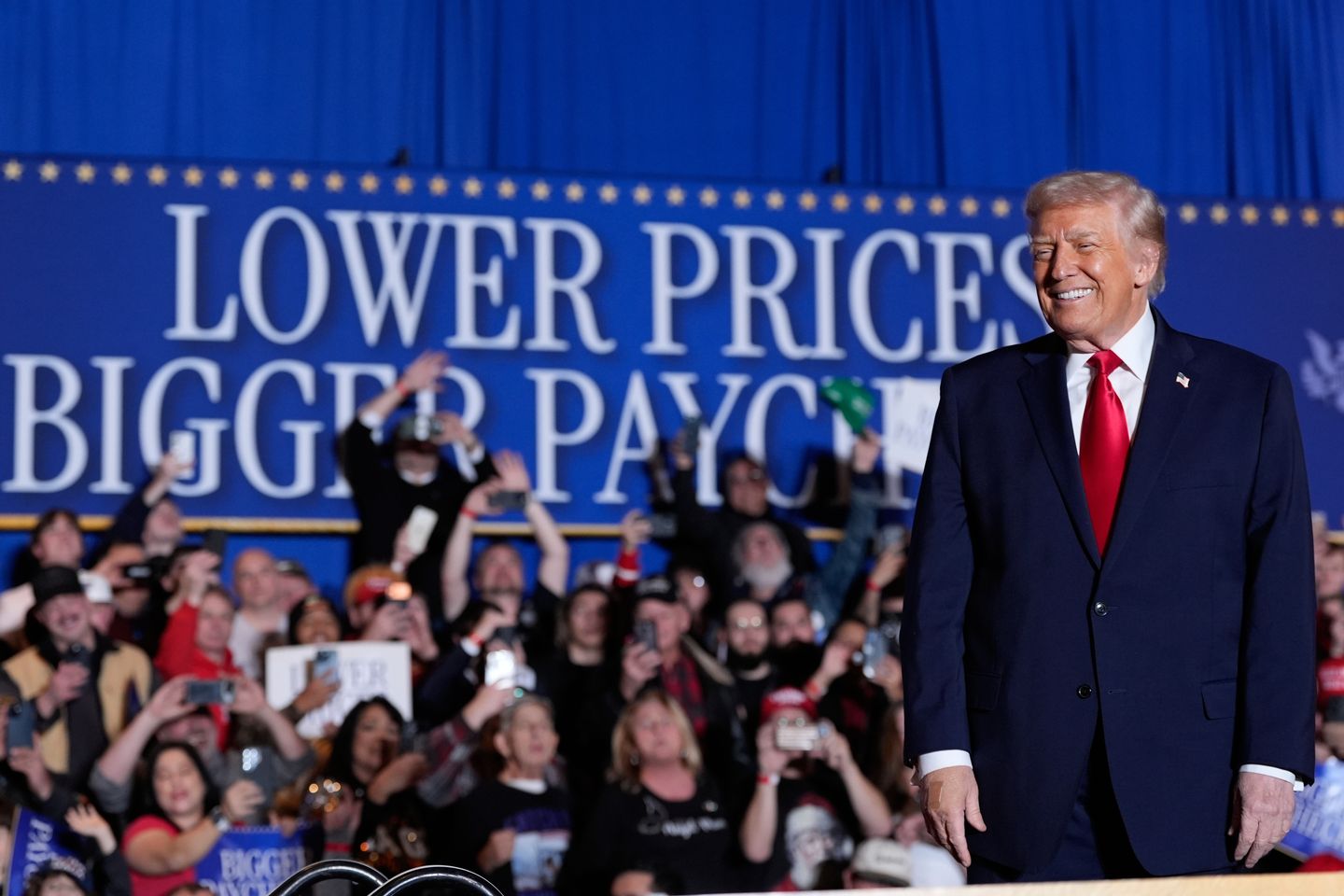
President Trump returned to campaign mode to sell his economic agenda as the cure for Americans’ frustration at the high cost of food and household goods, telling a Pennsylvania crowd that their wallets were emptier under President Biden.
He said Democrats and their allies in the news media were falsely blaming him for the “affordability issue” while ignoring the massive inflation of the Biden era that brought the high prices still afflicting Americans.
“Democrats talking about affordability is like Bonnie and Clyde preaching about public safety. And they truly are the enemy of the working class,” he said. “They gave you high prices. They gave you the highest inflation in history and were bringing those prices down rapidly. Lower prices, bigger paychecks.”
He also lambasted Democrats for wiping out Americans’ jobs with onerous environmental regulations that have choked the oil and gas industries.
Mr. Trump insisted that he has already brought down prices but also pleaded for patience. He said his tariff policy will continue to bring in billions of dollars in revenue and revitalize U.S. manufacturing.
“We’ve taken in hundreds of billions of dollars, really trillions,” Mr. Trump said in remarks from the Mount Airy Casino and Lodge in Mount Pocono, Pennsylvania. “If you add to that all of the companies that are pouring their money into building plants in Pennsylvania and other states, auto plants, AI plants, plants of every type, which we would never have if we didn’t put the tariffs on.”
Mr. Trump went on the offensive to push his economic message as Democrats seize on the issue for the 2026 midterm elections, with voters increasingly voicing dissatisfaction with the economy.
Mr. Trump’s tariffs will raise about $2.3 trillion from 2026 to 2035, according to data from the Tax Policy Center.
Ahead of Mr. Trump’s speech, the White House issued a fact sheet detailing ways it says Mr. Trump’s policies have put money back into Americans’ wallets. The White House stated that Mr. Trump’s deregulatory efforts, including the rollback of fuel efficiency standards, have saved Americans $180 billion, equivalent to $2,100 for a family of four.
The White House also said Mr. Trump’s tax cuts, including not taxing tips on overtime, have raised Americans’ take-home pay by as much as $13,000 and wages by as much as $11,600.
Under Mr. Trump, gas prices have fallen below $3 per gallon in 36 states and below $2.75 per gallon in 20 states. The average 30-year fixed-rate mortgage was 6.19%, a 12% decline from when Mr. Trump took office in January, according to the consumer price index, according to the White House data.
All that, the White House said, resulted in Americans’ real wages increasing by nearly 4%, or nearly $700, and could grow to as much as $1,200 by the end of Mr. Trump’s first full year in office.
In Mr. Trump’s second term, even after accounting for higher prices, Americans’ real wages have grown by nearly 4%, or nearly $700, and are on track to grow by nearly $1,200 after his first full year in office.
In recent weeks, Mr. Trump has taken an increasing number of actions to boost the economy. He eased tariffs on Brazilian coffee, fruit and beef to lower grocery costs. He rolled back fuel efficiency standards to make cars less expensive, struck a deal with pharmaceutical companies to reduce the cost of weight loss drugs, and floated the idea of 50-year mortgages, which would lower homeowners’ monthly payments.
The president also stepped up to support struggling farmers when he announced a $12 billion farm aid package Monday. Farmers had been hurt by Mr. Trump’s tariffs, increasing the cost of machinery, crops, beef and other equipment.
Mount Pocono is a working-class town in Monroe County, which Mr. Trump flipped in 2024 after Mr. Biden carried it in 2020. Monroe also sits adjacent to another swing district in a battleground state that could determine control of the House after elections next year.
The president’s remarks made it clear that he knows affordability, a buzzword adopted by both parties to describe voters’ economic despair, will be on the ballot ahead of the 2026 midterms. He will need to counter Democrats’ claims about the economy to keep the Republican majority in Congress.
In the November elections, voters in New Jersey, Virginia, and New York City elected Democrats, as they voiced concerns about the cost of living and turned up the heat on Mr. Trump. Since then, he has pushed back against critics who say he and, specifically, his tariffs, are to blame for high prices.
Delivering a prime-time speech in a swing state is a tacit acknowledgment by Mr. Trump and the White House that he needs to do more to rally Americans behind his economic policies. White House officials have said Mr. Trump will deliver similar speeches later this month and in the new year.
It is a stunning reversal for Mr. Trump, whose historic victory in last year’s election was largely because of highlighting Americans’ inflation concerns and hammering Mr. Biden, whose administration oversaw inflation reaching a stunning 9%.
More than a year after that victory, Mr. Trump has struggled to stay on message about the economy and, at times, was even dismissive of it, referring to affordability as a “Democratic hoax.” He has repeatedly blamed Mr. Biden, insisting he inherited a “mess” of an economy from his predecessor.
However, polls show American voters are disillusioned with Mr. Trump’s handling of the economy.
A recent Gallup poll revealed that 62% of Americans disapprove of his handling of the economy, compared with 36% who approve and 2% who have no opinion. A Fox News poll last month found that 76% of voters have negative views of the economy.
Compared with a year ago, voters say costs have increased “a lot” for a variety of necessities, including groceries (60%), utilities (78%), health care (67%), housing (66%) and gasoline (54%). Perhaps most alarming for Mr. Trump, the poll found that 46% of Americans say his economic policies have hurt the country compared with 15% who say they have helped. The poll also found that 42% of Republicans say Mr. Trump is to blame for the current economy.
James Mohs, an economics professor at the University of New Haven, said voters need to be patient. He said prices have come down somewhat under Mr. Trump, but it is difficult for prices to fall at the rapid rate Americans expect.
He said Mr. Trump is to blame for Americans’ impatience, referring to the president’s campaign promise to lower prices on Day 1.
“Trump promised too much too soon, but there is progress being made. Under the prior administration, inflation was around 8% or 9%. Trump has stabilized inflation at about 3%, and you need to stabilize inflation before you can bring it down.”
Mr. Mohs said some of the high prices are the result of a combination of factors, including thinning herds that have raised beef prices and Mr. Biden’s scaling back of domestic drilling.
“Trump’s whole plan is to increase domestic manufacturing and drill, baby, drill after the oil and gas leases were shut down under Biden,” he said. “All of that stuff takes time.”